
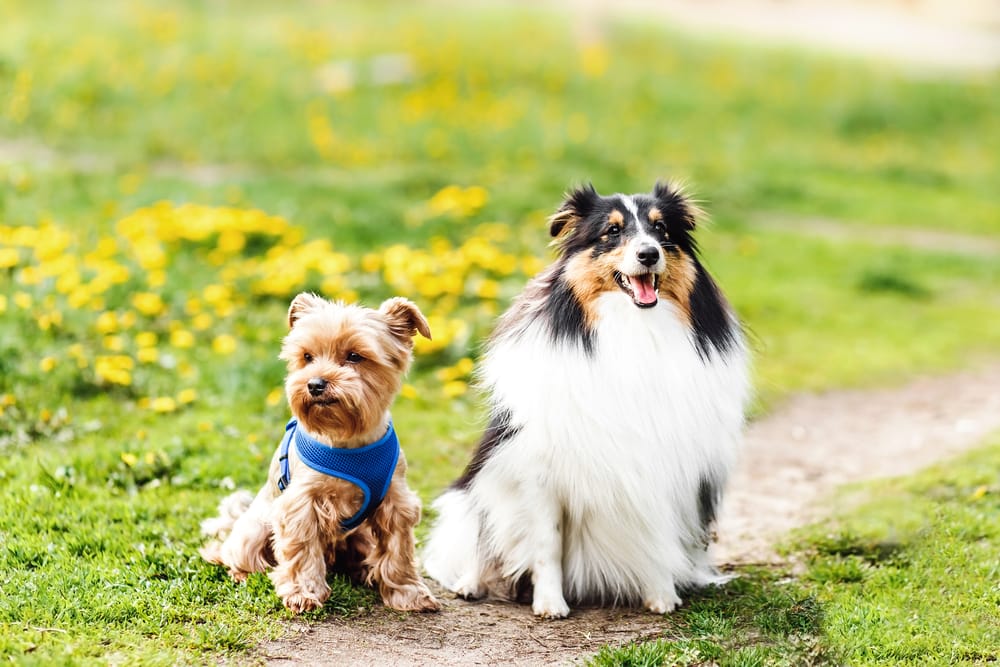
We hear it in the driveways so often. A client walks their dog out to the van, ready to have their pooch professionally groomed, sees us pull the comb out, and says, “Oh, he has hair, not fur.” Half the time it’s voiced as fact; the other half it sounds like a question. So is there a difference? Why yes, yes there is—but it’s not the difference most people think it is.
Why Dog Hair vs. Dog Fur Matters for Grooming
Hair and fur are both composed of keratin, and chemically there’s nothing to argue about. What actually matters to a groomer is how the coat grows, how it lets go of itself, whether there’s an undercoat hiding under the part you can see, and what that coat needs to stay healthy. Those factors decide whether your dog gets clipped, brushed out, blown out, or mostly left alone.
Where you live changes the math too. A Husky in Michigan and a Husky in Frisco don’t share the same summer. We deal with 100-degree stretches that run for weeks, sun that will burn a shaved back, humidity in May and September, cedar and ragweed pollen that settle into a coat, and winters mild enough that many dogs never fully finish shedding.
Essentially, we do not give every dog the same bath, haircut or schedule. When our mobile grooming van shows up, the first thing the groomer does is put hands on the coat.
Does Your Dog Have Hair or Fur?
Think about the growth cycle and it gets simple fast. Fur grows to a length your dog’s genetics already decided on. It reaches that length, rests, and eventually falls out. However, hair just keeps on growing! The active growth phase of hair runs much longer, and it grows until something cuts it or it breaks.
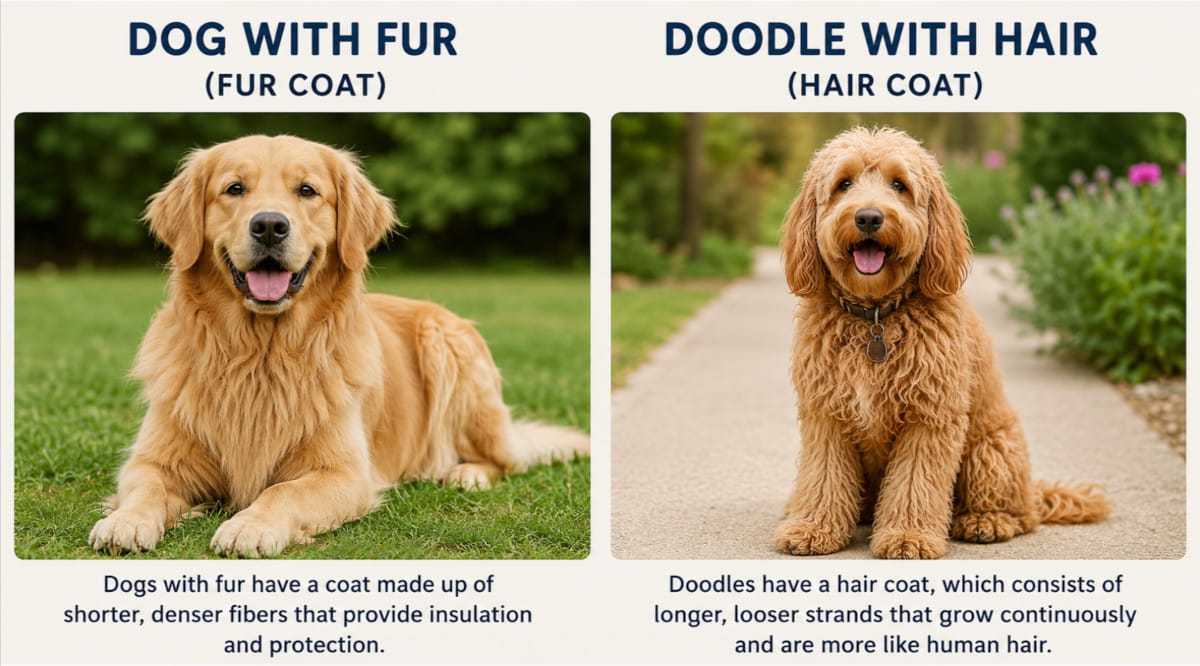
This is the whole reason a Lab can live 14 years and never sit for a haircut, while a Poodle that is never clipped has a coat that will keep getting longer.
Hair-type coats appear in these dogs.
- Poodle
- Maltese
- Havanese
- Yorkshire Terrier
- Bichon Frisé
- Shih Tzu
- Most Doodle Mixes
These are common fur-type and double-coated dogs.
- Golden Retriever
- Labrador Retriever
- German Shepherd
- Australian Shepherd
- Border Collie
- Siberian Huskie
- Pomeranian
- Samoyed
Breed lists only get you so far, though, as there are curly coats, silky coats, wire coats, smooth coats, single coats, double coats, and plenty of coats that are some combination nobody has a good name for. Mixed breeds pull traits from both parents and sometimes end up with a coat that behaves like neither one.
So we read the dog, not the breed name. Honestly, that’s one of the underrated benefits of mobile dog grooming. We’re looking at your dog’s coat at your house, in the same heat and the same yard that your dog deals with every day.
Does Your Dog Have an Undercoat?
For grooming purposes, this question matters more than whether you call it hair or fur. A double-coated dog has two layers doing two different jobs.
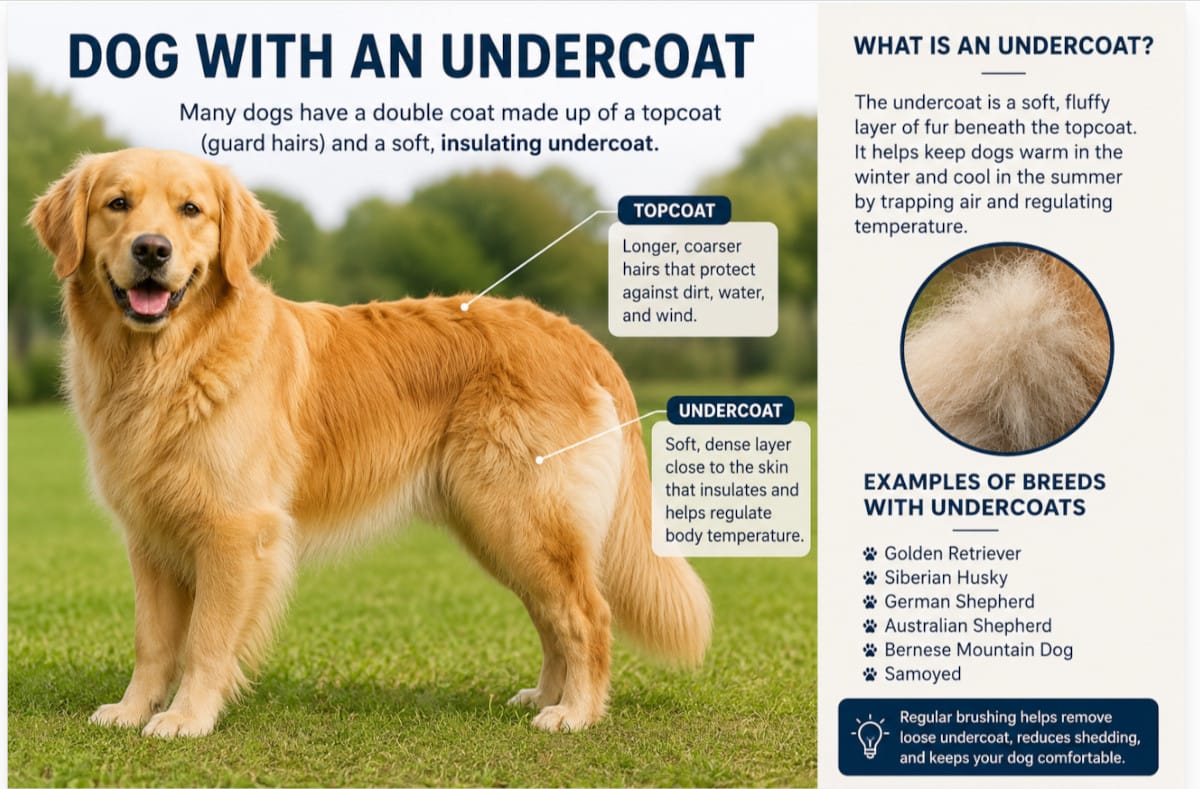
On top of the undercoat there are guard hairs. They’re more coarse, and shield the skin from sun, dirt and moisture. Underneath is the undercoat, softer and much denser, and that’s the insulation. The undercoat turns over much faster than the guard hairs. It will shed, grow back and shed again.
The above describes how a Golden Retriever produces enough loose fur in one appointment to build a second Golden Retriever, and that’s not just a figure of speech! On a heavy-coated Aussie in the middle of a coat blow, it’s a full trash bag of undercoat.
Now you understand why a shedding Golden and an overgrown Poodle need completely different services. One dog needs coat removed, and the other needs coat taken down. Miss that difference and you end up with the single most common mistake we see made on hot-climate dogs.
Should You Shave a Double-Coated Dog?
We get this question every June, usually the week the first triple-digit day hits. And look, it makes sense. Your Golden or Aussie or Husky is walking around in what looks like a parka. Taking it off seems like kindness, but note that for most healthy double-coated dogs, it is not.
That coat is doing real work. The undercoat insulates, and the guard hairs block sun and keep the skin covered. When it warms up the dog will dump a lot of that undercoat on its own, and what’s left is still protecting him.
Shave it all off and you do not get a cooler dog! You get a dog with exposed skin under some of the harshest sun in the country. And because the undercoat and guard hairs grow back at different rates, the coat that comes in afterwards can come in patchy, cottony, or in a different color than what was there previously. Sometimes it never really goes back to the original.
What a double-coated dog actually needs in a Dallas–Fort Worth July is the dead undercoat to be removed. Not the coat itself, but the dead undercoat.
The undercoat is of supreme importance, and it’s the difference between a comfortable dog and a sunburned one. Packed-in undercoat traps loose hair and moisture right against the skin, and in humid weather that skin has a hard time drying out. A proper bath, a high-velocity dry, a full brush-out and a deshedding appointment will pull out what the coat was already trying to release, while leaving the protective part alone.
How to Groom a Dog With Fur
With grooming, fur coats are maintained, they do not get progressively shortened. What that looks like depends on the dog.
- A Lab mostly needs a bath, a thorough dry, nails done, and every bit of loose coat out of him.
- A Golden needs deshedding plus cleanup on the feet, ears and furnishings.
- An Aussie needs serious undercoat work and a tidy-up that keeps his natural outline, rather than squaring him off.
- While a Pomeranian is also double-coated, the density is nothing like the others, and treating him like a small Golden is a good way to wreck his coat.
The goal for all of them is a healthy coat, not a bald one. That usually means a bath with a product picked for that dog’s skin, a complete rinse (the step people often skip), high-velocity drying that separates the coat and pushes the dead undercoat out, then brushing, combing and targeted deshedding.
Brushing between appointments matters more than most people think. It pulls dead hair before it packs down, and it moves the skin’s natural oils out through the coat.
One thing that catches North Texas owners off guard is that shedding here doesn’t follow the neat spring-and-fall pattern the breed books describe. Mild winters and long summers mean a lot of dogs shed in smaller waves year-round, instead of blowing coat twice. If your Golden seems to be blowing coat in December, you’re not imagining it—ours do it too.
How to Groom a Dog With Hair
Hair coats hand you the opposite problem. With a Golden, we’re asking how to get the dead coat out. With a Poodle, we’re asking how to keep a coat that never stops growing from turning into a problem.
Poodles are the obvious example. That long growth phase is exactly why regular haircuts are beyond cosmetic for them, they are literally maintenance.
The same principle applies to anything with a continuously growing coat. The coat keeps growing, brushing falls behind, and tangles start. Tangles become mats and mats tighten as the hair grows, and they end up sitting flat against the skin where they pull and block airflow.
Curly coats are sneaky about it. The outside looks like a cloud but underneath, close to the skin, it has become felted. That’s how a dog shows up looking like three inches of adorable fluff, and the groomer can’t get a comb through the first half-inch of it.
So the schedule is not about keeping a cute haircut, it’s about not letting the coat get to that point in the first place.
Why Does My Doodle Mat if He Doesn’t Shed?
Low shedding does not mean low maintenance – if anything, it’s the reverse. The dog is still losing hair, it just has nowhere to go. Instead of landing on your couch, the hair that’s been shed stays trapped in the curls around it. Add friction and continued growth, and you’ve built the perfect conditions for matting.
The friction spots appear first, every time.
- Behind the ears
- Under the collar
- Anywhere a harness rubs
- Armpits
- Legs
- Chest
- Belly
- Tail
The North Texas region adds a few more challenges. Dogs swim at Lewisville and Grapevine. They walk through wet Bermuda grass at 7:00 a.m., and sometimes get caught in one of those spring storms that shows up out of nowhere. Water plus an existing tangle equals a mat that tightens as it dries.
From the outdoors, your pup comes inside to the A/C, goes back out into the heat a bit later, and does it again tomorrow. Meanwhile, our yards are producing grass seed, burrs and pollen, and a curly coat grabs it all. Brushing has to go all the way down – do not rely on brush strokes across the top.
Try this quick test. If the brush glides beautifully but a comb won’t move from the skin outward, then the coat isn’t brushed, it just looks brushed.
Dogs With Hair Still Need Skin and Coat Care Treatments
There’s an idea floating around out there that hair-type dogs skip the usual skin and coat problems, but they absolutely do not.
A coat that stays on the dog for months needs protection from dryness and breakage, because nothing is replacing it. Fur coats have the opposite situation, constantly cycling out and requiring different conditioning.
It might seem that a dog shampoo is a dog shampoo – you just need one, right? But one shampoo to serve every dog breed is actually a bad idea. And it’s also why we carry hypoallergenic, oatmeal, brightening, odor cleanse, flea and tick, and medicated options in the van.
Density matters as much as the shampoo type itself. Anything you put on a double-coated dog has to get through the coat, then rinse all the way back out.
Rinsing and drying are where grooms are won or lost. A dog can look spotless and still have shampoo residue and moisture sitting deep in the coat, and that’s a fast track to hot spots in September humidity.
Do Short-Haired Dogs Need Grooming?
A short coat does not mean an easy coat. Frenchies, Beagles, Boxers, all of them may never need a haircut. However, they still shed, still build up dead skin and coat, still need nails done, and still do better with regular bathing and brushing.
Short-coated dogs can shed an impressive amount, actually. Those little hairs turn over constantly, and they can weave into upholstery and fabric in a way that long hair doesn’t.
So when someone tells us their dog doesn’t need grooming because he’s short-haired, we push back gently. He does not need a haircut, but that’s a different thing than not needing to be groomed.
How Often Should a Dog Be Professionally Groomed?
That question cannot be answered accurately when based on breed alone. This is what grooming frequency actually depends on.
- Coat type
- Coat length
- Density
- Shedding pattern
- Haircut style
- At-home brushing time
- Activity level
- Skin condition
- Speed of nail growth
- Day-to-day life
A Poodle sporting a longer style is a different job than the same Poodle when kept short. An Aussie brushed properly three times a week needs us less often than one who is not brushed between visits. Same dog, same coat, completely different schedule. A Lab that’s often in the lake or in a creek at every opportunity is not the same as a Lab who gets less “water time.”
If you want a starting point, most hair coats do well with a groom every 4–6 weeks, most double coats want a deshedding groom every 6–8 weeks, and short coats are usually fine at 8–12 weeks. Your groomer will move those numbers around once she’s seen the dog twice.
So it’s not “how often” a breed needs grooming. In fact the better question to ask is what a particular dog’s coat needs to stay clean, comfortable and manageable for you. And when grooming happens, each breed has its own distinct grooming needs.
Your Dog’s Coat Type Determines Its Grooming Needs
A pretty coat is nice, but a coat that’s doing its job is much better.
Hair coats need trimming, detangling and protection because they never stop growing, and fur coats need the old coat released without stripping out the healthy protective layer. Double coats need the undercoat managed, not shaved off. Short coats need skin and shedding care even though nobody’s touching them with clippers. Coats prone to tangles, such as long or curly coats, may also need professional dematting services on a regular basis to help keep their coats manageable, comfortable and looking their best.
And all of that depends on where the dog actually lives. Around here, that means heat, sun, humid stretches, cedar pollen in January, ragweed in fall, backyard adventures, and a lot of going back and forth between a 102-degree yard and a 71-degree living room.
There’s no single summer cut that works for every dog. If anyone’s selling you one, they aren’t looking at your dog.
The best grooms start before the clippers ever come on, with somebody reading the coat and skin and the way your dog lives. After this assessment they choose an approach that works with that coat, instead of fighting it.
It’s about more than sending your dog back into the house looking great, it’s about supporting a coat that holds up between visits, that’s easier for you to keep up with at home, and that gets your dog through another North Texas summer most comfortably.
Book Mobile Dog Grooming in North Texas
Not sure whether your dog needs a deshedding, a full haircut, or just a better routine at home? Tell us the breed and activity level and we’ll tell you how to get started. Primped Pooches Mobile Dog Spa has been grooming pets from their North Texas driveways since 2017. Call 214-817-0362 or schedule your pet’s grooming appointment online today.


